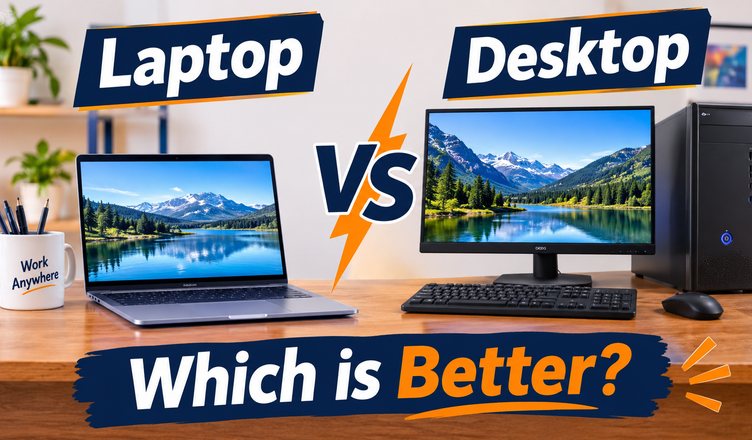
Choosing between a laptop and a desktop computer can be confusing, especially when both offer excellent features for everyday work, education, entertainment, and professional tasks. The Laptop Vs Desktop debate is not just about performance or price. It is also about how you work, where you use your computer, how much space you have, and what you expect from your investment. Some people prefer carrying their computers wherever they go, while others want a powerful machine that stays in one place. So, which option makes more sense?
Before spending your money, let’s compare both options based on practical usage, performance, portability, maintenance, and long-term value.
1. What Is a Laptop?
A laptop is a portable computer designed to perform various computing tasks without requiring a separate monitor, keyboard, or mouse. It comes with a built-in screen, keyboard, touchpad, battery, and other essential components.
You can carry it to your office, college, meetings, or even while travelling. Modern laptops are also powerful enough to handle professional software, video editing, graphic designing, programming, and digital marketing activities. Laptop Vs Desktop is an important comparison for anyone planning to buy a new computer in 2026.
For example, students can use laptops for online classes, assignments, research, and presentations. Similarly, professionals can manage emails, attend video meetings, prepare reports, and work remotely.
The biggest advantage is convenience. You don’t have to sit at a fixed desk every time you want to work.
2. What Is a Desktop Computer?
A desktop computer is a personal computer designed to stay at a fixed location, such as a home, office, or workplace. It generally consists of a CPU cabinet, monitor, keyboard, and mouse.
Unlike laptops, desktop computers usually have more room for larger cooling systems and powerful internal components. This makes them suitable for demanding activities such as professional video editing, gaming, animation, and heavy multitasking. Laptop Vs Desktop maintenance is another important factor because desktop components are generally easier to replace.
Another advantage is flexibility. You can upgrade individual components like RAM, storage, graphics cards, and sometimes the processor, depending on motherboard compatibility.
For people who spend several hours working at the same desk, a desktop can be a practical choice.
3. Laptop Vs Desktop: Key Differences
Laptop Vs Desktop helps students decide which device is more suitable for online classes, assignments, and studies. Let’s understand the major differences before making a final decision.
| Features | Laptop | Desktop |
|---|---|---|
| Portability | Easy to carry | Not portable |
| Performance | Good to excellent | Excellent upgrade options |
| Price | Often costs more for similar performance | Generally better value |
| Power consumption | Usually lower | Usually higher |
| Upgrade options | Limited | More flexible |
| Battery | Built-in battery | Requires external power |
| Space | Requires less space | Requires dedicated space |
| Maintenance | Can be difficult | Generally easier |
In my opinion, neither option is automatically better. The right choice depends on your daily requirements and available budget.
4. Performance: Which One Is More Powerful?
Performance is one of the biggest factors when comparing a laptop and a desktop.
Desktop computers generally offer better performance at a similar price, particularly for demanding workloads. They also have better cooling potential, which helps maintain performance during long working sessions.
However, modern laptops have improved significantly. Many premium laptops can handle programming, photo editing, video editing, and other resource-intensive applications without major problems. Laptop Vs Desktop is also a common consideration for professionals who need a reliable computer for office work.
For example, if you regularly edit 4K videos or work with complex 3D designs, a powerful desktop may offer better value. On the other hand, if you mainly use Microsoft Office, web browsers, Photoshop, and digital marketing tools, a good laptop may be more than sufficient.
5. Portability and Convenience
This is where laptops clearly have an advantage.
Imagine you are a college student who needs to attend online classes, prepare presentations, and work on assignments. Carrying a laptop makes everything easier.
Similarly, professionals who travel frequently can work from hotels, cafes, airports, or client offices.
A desktop cannot offer this flexibility. Once installed, moving it to another location requires disconnecting and transporting several components. Laptop Vs Desktop offers two different experiences when it comes to portability and convenience.
My suggestion is simple: if you need to work from different locations, don’t compromise on portability. A laptop will make your daily routine much easier.
6. Price and Budget: Which Offers Better Value?
Budget is another important consideration.
Generally, desktops provide better performance per rupee because manufacturers can use larger components and more effective cooling systems without worrying about battery size or portability.
For example, if your budget is ₹50,000, you may find a desktop configuration offering better graphics performance and upgrade possibilities than a laptop at the same price.
However, remember that a desktop setup also requires a separate monitor, keyboard, mouse, and possibly a webcam or UPS.
A laptop includes most of these components in one package.
Therefore, when comparing the cost of Laptop Vs Desktop, consider the complete setup rather than looking only at the advertised price.
7. Gaming and Entertainment
Gaming enthusiasts often prefer desktop computers because they offer better cooling, graphics upgrade options, and support for larger monitors. Laptop Vs Desktop performance depends on the processor, RAM, storage, graphics, and overall configuration.
A gaming desktop can also be upgraded over time instead of replacing the entire machine.
That doesn’t mean laptops are unsuitable for gaming. Gaming laptops with dedicated graphics cards can run many modern games smoothly. They are especially useful for people who want to enjoy gaming while travelling.
For watching movies, browsing the internet, and streaming videos, both options work perfectly well.
8. Maintenance and Upgrades
Desktop computers are generally easier to maintain and upgrade.
For example, if your desktop starts running slowly, you can upgrade its RAM, install an SSD, or replace certain components without purchasing an entirely new computer.
Laptops are different. Some models allow RAM or SSD upgrades, while others have soldered memory and limited repair options.
One complaint I have about many modern laptops is that manufacturers are making components increasingly difficult to replace. This can become expensive when a particular component fails after the warranty period. Laptop Vs Desktop pricing can vary depending on the brand, specifications, and features.
Before purchasing a laptop, always check its RAM configuration, storage upgrade options, warranty, and service availability.
9. Laptop Vs Desktop: Which Is Better for Different Users?
Here are some practical recommendations based on everyday requirements:
- Students: A laptop is generally better because it supports online learning, assignments, presentations, and research.
- Office professionals: Choose a laptop if you attend meetings or work remotely. A desktop is suitable for fixed office environments.
- Digital marketers: A laptop is convenient for SEO, content writing, social media management, Google Analytics, and online marketing campaigns.
- Video editors: A powerful desktop is generally a better investment for demanding editing projects.
- Gamers: Desktop computers offer better upgrade flexibility, although gaming laptops are useful for portability.
- Home users: Both are suitable for browsing, entertainment, online shopping, and general computer activities.
10. Final Verdict: Which One Should You Buy?
After comparing their features, advantages, and limitations, I believe the decision comes down to your lifestyle and working requirements.
If you are a student, freelancer, digital marketer, or working professional who needs flexibility, a laptop is a sensible investment. Laptop Vs Desktop gaming capabilities are different, as desktops generally offer better cooling and upgrade options.
However, if you need maximum performance, better upgrade options, and a comfortable fixed workstation, a desktop computer deserves serious consideration.
My personal suggestion is not to purchase an expensive computer simply because it has impressive specifications. First, understand what you actually need. Spending ₹80,000 on a powerful machine doesn’t make sense if your daily work involves only browsing, emails, and documents.
The best computer is the one that makes your work easier, saves time, and delivers good value for your money.
Frequently Asked Questions (FAQs)
1. Is a laptop better than a desktop for students?
Yes, a laptop is generally more convenient for students because they can carry it to college, libraries, coaching classes, and other places.
2. Which is cheaper, a laptop or a desktop?
Desktop computers generally offer better performance for the same budget. However, remember that a desktop requires additional accessories such as a monitor, keyboard, and mouse.
3. Can a laptop replace a desktop computer?
Yes. Modern laptops can handle most everyday professional tasks, including office work, programming, content creation, and digital marketing.
4. Which computer is better for gaming?
A desktop is generally better for gaming because of its cooling capabilities, graphics upgrade options, and performance potential. Gaming laptops are a good alternative when portability matters.
5. Which computer lasts longer, a laptop or a desktop?
Both can last several years with proper maintenance. However, desktops are generally easier and sometimes cheaper to repair or upgrade.
6. Is 16GB RAM enough for everyday use?
Yes, 16GB RAM is sufficient for most everyday activities, office work, multitasking, browsing, and many professional applications. Heavy video editing and demanding workloads may require more memory.
7. Should I buy a laptop or desktop in 2026?
Choose a laptop if portability and convenience are your priorities. Choose a desktop if performance, upgrade flexibility, and long working sessions matter more to you.
My Final Suggestion: Before purchasing, compare the processor, RAM, SSD storage, display quality, warranty, and after-sales service. Don’t make your decision based only on the brand name or price.