
Introduction
Home security has become an important consideration for homeowners, especially as modern houses increasingly depend on technology for monitoring and protection. One of the most practical technologies used for this purpose is Installing CCTV cameras at home.
Installing CCTV cameras at home can help homeowners monitor entrances, outdoor areas, parking spaces, corridors, and other important locations. However, buying a camera is only one part of creating an effective home security system. Camera type, placement, storage, connectivity, lighting, and privacy all influence how well a CCTV system performs.
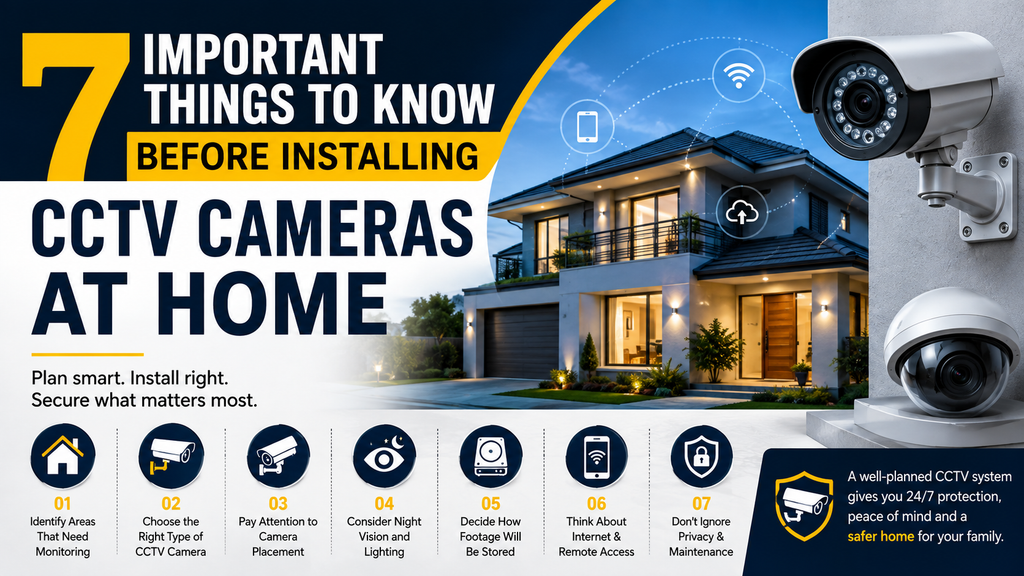
Before starting a CCTV camera installation, it is useful to understand the basic factors that can affect coverage and reliability. Here are seven important things homeowners should consider.
1. Identify the Areas That Need Monitoring
The first step is deciding where cameras are actually required. Installing cameras randomly can result in unnecessary coverage in some areas while leaving important locations unmonitored.
Common areas that may require monitoring include the main entrance, back door, garage, driveway, parking area, staircase, balcony, and other access points.
For indoor monitoring, cameras can be considered for areas such as hallways, living-room entrances, or other common spaces. Bedrooms and private areas generally require greater consideration because of privacy concerns.
Before purchasing a CCTV cameras at home, walk around the property and identify locations where security monitoring provides the most value.
2. Choose the Right Type of CCTV Camera
Not every CCTV camera is designed for the same environment. Understanding the different types can help homeowners select suitable equipment.
An indoor CCTV cameras at home is generally designed for protected indoor environments, while an outdoor CCTV camera needs to withstand environmental conditions such as rain, dust, humidity, and temperature changes.
There are also dome cameras, bullet cameras, PTZ cameras, Wi-Fi cameras, wired cameras, and other specialized options.
The choice should depend on the location, required viewing area, lighting conditions, installation method, and monitoring requirements rather than simply selecting the camera with the highest specifications.
3. Pay Attention to Camera Placement
Even a high-quality camera may provide poor results if it is installed in the wrong position.
Security camera placement should provide a clear view of the area that needs monitoring while minimizing blind spots. Entrances should generally be positioned so that the camera can capture useful details of people approaching the property.
The height of the camera also matters. If it is installed too high, important details may become difficult to identify. If it is installed too low, the camera may become easier to tamper with.
Homeowners should also consider potential obstructions such as trees, walls, gates, decorative objects, or vehicles that could block the camera’s field of view.
4. Consider Night Vision and Lighting
Security monitoring should not stop after sunset. Lighting conditions can have a major impact on CCTV footage.
When selecting CCTV cameras at home, check whether the camera provides suitable night-vision capability for the intended location. Infrared night vision is commonly used to capture images in low-light or dark conditions.
However, night vision performance can vary between cameras. The distance that can be effectively monitored at night, surrounding lighting, reflective surfaces, and environmental conditions can all affect image quality.
Additional lighting may also improve visibility around entrances, driveways, and other outdoor areas.
5. Decide How CCTV Footage Will Be Stored
Recording storage is another important consideration when setting up a CCTV camera system.
Depending on the system, footage may be stored on a Digital Video Recorder (DVR), Network Video Recorder (NVR), memory card, or cloud-based storage platform.
The amount of storage required depends on several factors, including the number of cameras, recording resolution, frame rate, recording schedule, and retention period.
Continuous recording generally requires more storage than motion-based recording. Homeowners should therefore determine how long they want footage to remain available and choose an appropriate storage solution.
It is also important to regularly check whether the storage system is functioning correctly. A camera that is recording but unable to save footage does not provide much practical value during an incident.
6. Think About Internet and Remote Monitoring
Modern home security cameras may provide remote viewing through smartphones, tablets, or computers. This can allow homeowners to check camera feeds when they are away from the property.
However, remote access depends on the system’s network configuration and internet connectivity. Wi-Fi cameras may also be affected by weak wireless signals, interference, or network interruptions.
For important security locations, homeowners should consider whether a wired connection would provide greater reliability.
If remote monitoring is enabled, account security is equally important. Strong passwords, updated software, secure network settings, and appropriate access controls can help reduce unauthorized access to the CCTV system.
7. Do Not Ignore Privacy and Maintenance
CCTV cameras can improve security, but they should be installed and used responsibly.
Before installing CCTV cameras at home, homeowners should consider whether the cameras are unnecessarily capturing neighboring properties, public areas, or private spaces. Local laws and regulations concerning surveillance and privacy should also be considered.
Maintenance is another factor that is often overlooked. Outdoor cameras can accumulate dust, dirt, insects, or water spots on their lenses. These can reduce image quality over time.
Cameras, cables, recording equipment, storage devices, and network connections should be checked periodically. Firmware and software should also be updated when appropriate.
Regular maintenance can help ensure that the CCTV surveillance system continues to work when it is actually needed.
Wired vs. Wireless CCTV Cameras
One common decision homeowners face is whether to choose wired or wireless cameras.
Wired CCTV systems can provide a stable connection and are often suitable for permanent installations. However, installation may require cable routing and more planning.
Wireless or Wi-Fi cameras can offer greater flexibility and may be easier to install in certain locations. Their performance, however, can depend on wireless signal strength and network reliability.
Neither option is automatically best for every home. The property’s layout, network environment, installation requirements, and monitoring objectives should guide the decision.
Conclusion
Installing CCTV cameras at home involves more than choosing cameras with attractive specifications. Effective home surveillance depends on selecting suitable camera types, identifying important monitoring areas, planning proper camera placement, considering night vision, choosing appropriate storage, securing remote access, and maintaining the system regularly.
A well-planned home CCTV camera setup can provide useful visibility around a property and make security monitoring more organized. By considering these seven factors before installation, homeowners can avoid common planning mistakes and create a CCTV system that better matches their actual security requirements.
The goal should not be to install the maximum number of cameras. Instead, the objective should be to achieve meaningful coverage, reliable recording, responsible surveillance, and practical long-term use.