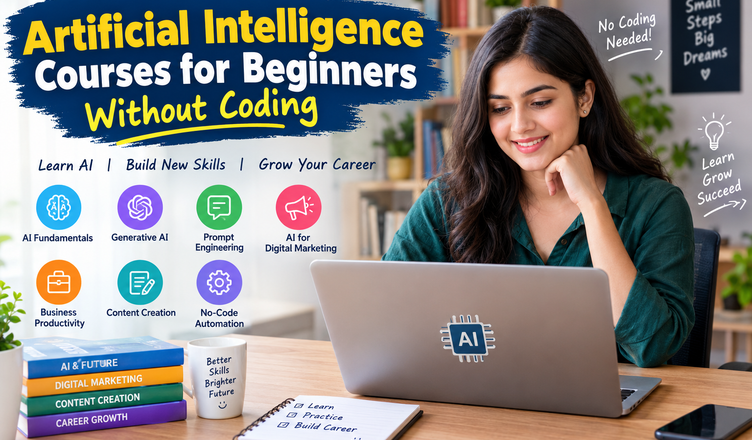
Artificial intelligence is no longer limited to software engineers, data scientists, or people with advanced technical degrees. Artificial Intelligence Courses for non-technical background can provide a practical way to understand AI tools. Today, students, marketing professionals, business owners, teachers, content writers, and even people working in traditional office jobs can learn how to use AI in their daily work. The important thing is to choose a course that matches your current skills and career goals.
For beginners, Artificial Intelligence Courses for non-technical background can provide a practical way to understand AI tools, improve productivity, and explore new career opportunities without immediately learning complicated programming languages.
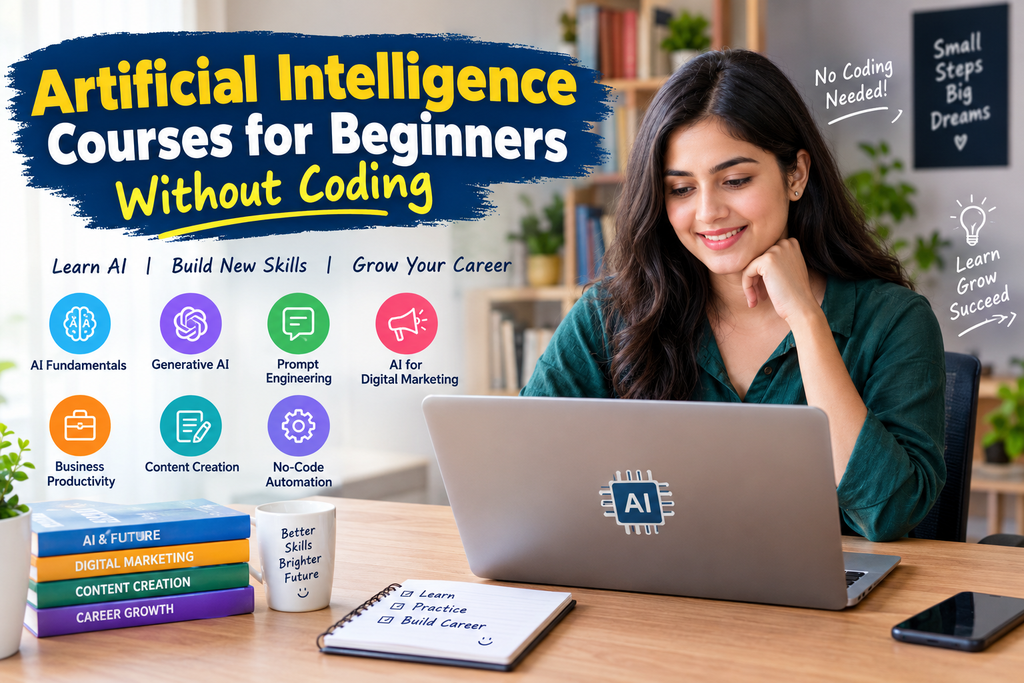
However, choosing the right course is not always easy. Some courses introduce AI through simple examples, while others quickly move into mathematics, coding, and machine learning algorithms. If you are starting from zero, understanding these differences can save you time and money.
Why Should Non-Technical People Learn Artificial Intelligence?
Think about the work you do every day. You might prepare reports, write emails, manage social media accounts, create presentations, research competitors, or communicate with customers. AI tools can help with many of these activities when they are used carefully.
For example, a digital marketer can use AI to brainstorm blog topics, develop content outlines, and analyse customer feedback. A small business owner can use AI to draft product descriptions, prepare customer support responses, and organise business ideas.
In my opinion, beginners should focus on practical applications before worrying about advanced technical concepts. Understanding what AI can do, where it makes mistakes, and how to check its output is often more useful at the beginning than trying to learn everything at once.
The right Artificial Intelligence Courses for non-technical background should explain these concepts in simple language and include exercises that learners can practise independently.
1. AI Fundamentals and Introduction to Artificial Intelligence
An AI fundamentals course is a sensible starting point for someone who has never studied artificial intelligence. It generally explains what AI is, how machine learning differs from traditional programming, and how AI applications are used in everyday life.
Look for beginner-friendly courses such as AI for Everyone by DeepLearning.AI, taught by Andrew Ng. It introduces AI concepts and discusses how organisations can identify opportunities to use AI without requiring learners to become programmers.
Practical uses: This course can help office professionals understand where AI may improve their existing responsibilities. Business owners can also use the knowledge to identify suitable tasks for automation and have more informed discussions with technical teams.
2. Generative AI Courses
Generative AI courses teach learners how tools can produce text, images, summaries, ideas, and other content in response to instructions. Depending on the course, you may learn prompt writing, responsible AI use, content improvement, and ways to evaluate generated results.
Beginners can explore introductory learning resources from Google, Microsoft, or DeepLearning.AI. Before enrolling, check the syllabus to confirm that the lessons cover practical applications rather than focusing mainly on technical development.
Practical uses: Content writers can develop article outlines, improve drafts, and generate ideas for social media posts. Students and office employees can use generative AI to summarise material, prepare presentations, and organise research, while checking important facts before using the results.
3. Prompt Engineering Courses
Prompt engineering is the practice of giving AI tools clear instructions so they can produce more relevant and useful responses. A good beginner course teaches you to provide context, specify the desired format, set limitations, and refine instructions when the first answer is not satisfactory.
You do not need a computer science degree to practise these skills. However, prompt engineering is not simply about memorising ready-made prompts; understanding the task and reviewing the result are equally important.
Practical uses: Digital marketers can create structured prompts for keyword research ideas, campaign planning, audience profiles, and content briefs. Teachers, recruiters, and administrative professionals can also use prompts to organise information and prepare first drafts more efficiently.
4. AI for Digital Marketing
People working in SEO, social media, email marketing, advertising, and content creation may benefit from courses that focus specifically on AI-powered marketing. These courses often cover campaign ideas, customer segmentation, content planning, marketing automation, and performance analysis.
When comparing courses, look for practical assignments involving real marketing tasks. AI can speed up research and content preparation, but it cannot guarantee higher rankings, more sales, or successful campaigns without sound strategy and human judgement.
Practical uses: SEO professionals can use AI to develop content briefs, organise search intent research, and identify questions that an article should answer. Social media managers can create content calendars and draft variations of advertisements before testing them with actual audiences.
For people exploring Artificial Intelligence Courses for non-technical background, this option can be particularly relevant when they already have marketing experience and want to add AI skills to their existing services.
5. AI Tools for Business Productivity
Business productivity courses focus on using AI to complete everyday tasks more effectively. Depending on the syllabus, they may cover AI-assisted spreadsheets, document creation, meeting summaries, presentations, research, and workflow automation.
Microsoft and Google provide learning resources related to their AI-powered productivity tools. Features and course availability can change, so review the current syllabus and confirm whether the lessons match the software you already use.
Practical uses: An administrative employee can use AI to prepare meeting agendas, summarise lengthy documents, and draft routine communications. A small business owner can use it to organise customer enquiries, create standard operating procedures, and prepare initial versions of business reports.
6. AI for Content Writing and Content Creation
If you enjoy writing but struggle with research, planning, or generating fresh ideas, an AI content creation course may be worth considering. It should cover research assistance, outlining, editing, tone adjustment, fact-checking, and the ethical use of generated content.
One concern I have about this area is that some learners become too dependent on AI-generated drafts. Publishing unverified information or generic articles can damage reader trust. AI works better as an assistant than as a replacement for original thinking, experience, and careful editing.
Practical uses: Bloggers can use AI to brainstorm article topics, create outlines, and identify gaps in an existing draft. YouTube creators can prepare video outlines, title variations, descriptions, and scripts while adding their own observations, examples, and presentation style.
7. No-Code AI and Automation Courses
No-code AI courses introduce ways to build simple workflows without writing extensive code. Depending on the programme, learners may explore visual automation platforms, connect applications, organise incoming information, and create basic AI-assisted processes.
Some automation tools still require technical configuration, paid subscriptions, or an understanding of data permissions. Beginners should therefore start with small, low-risk projects rather than trying to automate an entire business immediately.
Practical uses: A freelancer could create a workflow that organises form submissions and prepares draft replies for review. A small business could connect selected applications to reduce repetitive data entry, provided that customer information is handled securely.
How to Choose the Right AI Course
Before paying for any programme, take a little time to compare the learning objectives, practical exercises, instructor support, and total cost.
Here are a few suggestions:
- Start with your goal: Choose AI fundamentals if you want a general introduction, or marketing-focused AI if you already work in digital marketing.
- Check the prerequisites: A course labelled beginner-friendly may still expect basic spreadsheet skills or familiarity with certain applications.
- Prefer practical assignments: Choose a programme that helps you create something useful, such as a content plan, presentation, or simple automated workflow.
- Try free resources first: Introductory lessons can help you decide whether a subject interests you before spending money.
- Build a small portfolio: Save examples of your work, explain how you used AI, and show how you checked and improved the final result.
- Read the course details carefully: A certificate may demonstrate that you completed a programme, but it does not automatically guarantee a job or higher salary.
When researching Artificial Intelligence Courses for non-technical background, do not assume that the most expensive course is the most suitable. A clear, practical course that fits your current needs can be more useful than an advanced programme that covers subjects you are not ready to study.
Can You Build a Career in AI Without Coding?
Yes, there are roles where practical AI knowledge can complement existing professional skills without requiring you to become an AI engineer. Examples include AI-assisted content creation, marketing operations, business analysis, workflow coordination, and AI adoption support.
The requirements vary by employer and role. Some positions require programming, statistics, or technical qualifications, while others place greater emphasis on communication, domain knowledge, problem-solving, and the responsible use of AI tools.
My suggestion is to combine AI learning with a skill you already have. A marketer who understands SEO, for example, may find it more practical to learn AI-assisted research and campaign workflows than to start by studying advanced machine learning mathematics.
The long-term value of Artificial Intelligence Courses for non-technical background depends on how well you apply what you learn to genuine problems. Keep practising, review your results, and learn how to recognise errors instead of accepting every AI response at face value.
Frequently Asked Questions (FAQs)
1. Can I learn artificial intelligence without a technical background?
Yes. You can begin with AI fundamentals, generative AI, prompt engineering, or business productivity courses. Programming becomes necessary for some advanced subjects, but it is not a requirement for every AI-related learning path.
2. Which AI course should a complete beginner choose?
An introductory course such as AI for Everyone by DeepLearning.AI is a reasonable starting point. After understanding the basics, choose a specialised course based on your interests, such as digital marketing, content creation, or business automation.
3. Are free AI courses available?
Yes. Several providers offer free introductory lessons or learning materials, although certificates, advanced modules, and some platform features may require payment. Check the provider’s current pricing and course conditions before enrolling.
4. How long does it take to learn AI?
You can understand basic concepts and practise simple tools within a few weeks if you study consistently. Developing strong practical skills takes longer and depends on your starting knowledge, learning schedule, and the complexity of the tasks you want to perform.
5. Do AI courses guarantee a job?
No. A course can help you build knowledge, but employment also depends on practical ability, experience, communication, portfolio quality, and the requirements of the role. Use your learning to create demonstrable projects rather than relying only on a certificate.
6. What should I do after completing an AI course?
Choose one practical project related to your work or interests. For example, create a content calendar, prepare a research report, or build a simple workflow. Document your process, check the results, and gradually take on more challenging tasks.
Final Thoughts
Artificial intelligence is becoming a useful part of many professions, but learning it does not mean you must change your entire career. Start with the tasks you already understand, choose a course that explains AI clearly, and practise with real examples.
The most suitable Artificial Intelligence Courses for non-technical background are those that help you turn basic knowledge into practical skills. With patience, consistent practice, and a willingness to verify AI-generated information, you can make AI a valuable addition to your professional toolkit.