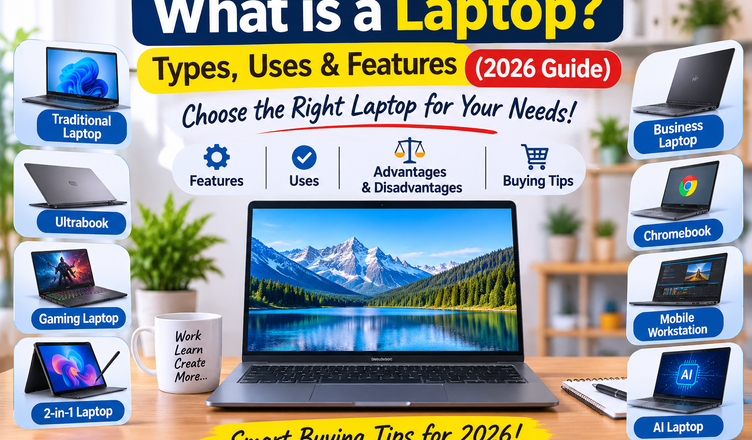
Technology has become an important part of our everyday lives. In this guide, we will explain What is Laptop and its types, how laptops work, their important features, practical uses, advantages, disadvantages, and what you should consider before purchasing a laptop in 2026. Whether we are attending online classes, working from home, managing a business, watching movies, editing videos, or simply browsing the internet, computers have made many activities easier. Among all computing devices, laptops have become particularly popular because they offer flexibility, portability, and convenience.
A few years ago, owning a laptop was considered a luxury for many people. Today, it has become an essential device for students, working professionals, business owners, freelancers, and even homemakers. You can carry your work wherever you go without depending on a fixed computer desk. Understanding What is laptop and its types helps you choose the right computer according to your personal and professional needs.
However, choosing the right laptop is not always easy. There are different models, processor options, screen sizes, storage capacities, and operating systems available in the market. If you are planning to purchase one, understanding the basics can help you avoid spending money on features you may never use.
1. What Is a Laptop?
A laptop is a portable personal computer designed to perform various computing activities without requiring a permanent desk setup. Unlike a traditional desktop computer, a laptop combines several components, including a screen, keyboard, touchpad, processor, memory, storage, speakers, webcam, and rechargeable battery in one compact device.
The biggest advantage of a laptop is portability. You can use it at home, in an office, at college, in a library, or while travelling. Most laptops can operate using their internal battery, although you need a power adapter to recharge them.
For someone learning about computers, understanding What is Laptop and its types is a good starting point because it explains how different laptop designs meet different requirements.
A laptop can perform almost all the everyday tasks that a desktop computer can handle. You can create documents, prepare presentations, browse websites, attend video meetings, edit photographs, develop software, and enjoy entertainment. If you are planning to purchase a new computer, learning What is laptop and its types can make your buying decision easier.
In simple words, a laptop is a computer that gives you the freedom to work and learn from almost anywhere.
2. How Does a Laptop Work?
What is Laptop and its types works through a combination of hardware and software components. Each component has a specific responsibility, and together they allow the device to perform different activities.
Here are the important components:
Processor (CPU): The processor is often called the brain of a laptop. It handles instructions and performs calculations. Intel and AMD offer several processor families designed for different performance requirements. Apple also develops its own processors for Mac computers.
RAM (Random Access Memory): RAM temporarily stores information required by currently running applications. More RAM generally makes multitasking smoother. For general use in 2026, 16GB is a comfortable target, although basic users may manage with 8GB.
Storage (SSD): Storage keeps your operating system, software, photographs, videos, and documents. SSDs are generally much faster than traditional hard disk drives. A 512GB SSD is a practical option for many everyday users.
Display: The display is where you see everything. Screen resolution, brightness, colour quality, and panel technology affect your viewing experience.
Battery: A rechargeable battery allows you to use the laptop without keeping it connected to a power outlet.
Keyboard and Touchpad: These are the primary input devices. A comfortable keyboard and responsive touchpad can make a significant difference if you work for several hours daily.
Graphics Processing Unit (GPU): The GPU processes images, videos, animations, and graphics. Integrated graphics are sufficient for regular activities, while dedicated graphics cards are useful for gaming and demanding creative work.
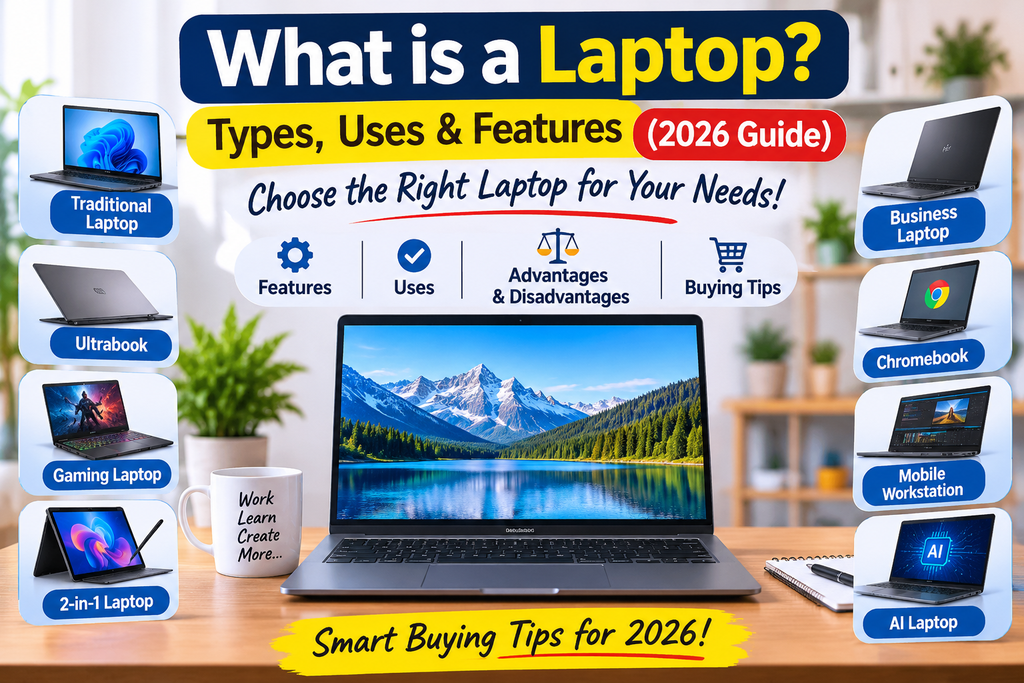
3. What Is Laptop and Its Types? Different Types of Laptops in 2026
Not every laptop is designed for the same purpose. Some are made for everyday activities, while others are built for gaming, professional work, or creative projects.
Let’s understand the major categories.
1. Traditional or Standard Laptop
A traditional laptop is the most common type. It comes with a regular screen, built-in keyboard, touchpad, and a hinged design.
These laptops are suitable for students, home users, office employees, and people who need a computer for everyday activities.
Common uses:
- Internet browsing and email.
- Microsoft Word, Excel, and PowerPoint.
- Online classes and meetings.
- Watching movies and listening to music.
- Managing personal and business documents.
If you want a laptop for regular work without spending too much on specialised features, this category is worth considering.
2. Ultrabook or Thin-and-Light Laptop
Ultrabooks and other thin-and-light laptops are designed for people who travel frequently or carry their devices every day. Different categories explain What is laptop and its types, including standard laptops, gaming laptops, ultrabooks, and 2-in-1 devices.
They are generally lightweight, slim, and easy to fit inside a backpack. Many models also focus on battery efficiency and premium build quality.
Common uses:
- Business meetings.
- Freelancing and remote work.
- Business travel.
- Presentations and office applications.
- Everyday productivity.
Their main limitation is that some thin models offer fewer ports, limited upgrade options, or less powerful cooling systems.
3. Gaming Laptop
What is laptop and its types is different in the point of view of Gaming. Gaming laptops are designed to handle demanding computer games and graphics-intensive applications.
They generally include powerful processors, dedicated graphics cards, advanced cooling systems, and displays with higher refresh rates.
Common uses:
- Playing modern PC games.
- Live streaming.
- Video editing.
- 3D modelling.
- Graphics-intensive applications.
One thing I would suggest is not to purchase a gaming laptop simply because it looks attractive. Gaming models can be expensive, heavier, and more demanding on battery power. If you only use MS Office, browse websites, and watch videos, you probably don’t need one. Students should understand What is laptop and its types before selecting a device for online classes, assignments, and research.
4. 2-in-1 Convertible Laptop
A 2-in-1 laptop combines the functionality of a traditional laptop and a tablet.
Depending on the design, its display can rotate through 360 degrees or detach from the keyboard. Many models also support touchscreen input and a digital pen.
Common uses:
- Digital note-taking.
- Online education.
- Drawing and designing.
- Business presentations.
- Reading and entertainment.
These laptops are particularly useful for students and professionals who prefer touchscreen interaction.
5. Business Laptop
Business laptops are developed for office environments, professionals, and organisations.
They often focus on security, durability, comfortable keyboards, reliable connectivity, and business management features.
Common uses:
- Corporate work.
- Managing business accounts.
- Video conferencing.
- Handling confidential documents.
- Working with spreadsheets and presentations.
If you work for long hours, I would recommend paying attention to keyboard quality, webcam quality, warranty, and security features rather than focusing only on processor speed.
6. Chromebook
A Chromebook is a laptop that runs Google’s ChromeOS instead of Windows or macOS.
It is primarily designed for internet-based activities and applications. Chromebooks are commonly used for online education, browsing, document creation, and cloud-based work.
Common uses:
- Online classes.
- Google Docs and Sheets.
- Web browsing.
- Email communication.
- Streaming entertainment.
However, Chromebooks may not support all traditional Windows desktop applications. Before buying one, check whether your required software is compatible. Knowing What is laptop and its types also helps working professionals find suitable devices for office work, business meetings, and multitasking.
7. Mobile Workstation
What is laptop and its types – Mobile workstations are high-performance laptops designed for specialised professional tasks.
They may include powerful processors, professional graphics solutions, higher memory capacities, and support for demanding applications.
Common uses:
- Engineering and CAD applications.
- Architecture and 3D modelling.
- Professional video production.
- Scientific computing.
- Advanced design projects.
These machines are generally expensive and unnecessary for ordinary home or student use.
8. AI Laptop
AI laptops are an important development in the 2026 computing market. Some models include a dedicated Neural Processing Unit (NPU), which is designed to handle certain artificial intelligence tasks efficiently.
Depending on the hardware and software, these devices can support features such as background effects during video calls, live captions, image processing, and selected on-device AI applications.
Common uses:
- AI-assisted productivity.
- Image and video processing.
- Supported voice and language features.
- Local AI applications.
- Everyday multitasking.
Remember that not every laptop advertised as an AI laptop offers identical capabilities. Check its actual processor, NPU specifications, supported software, and memory before purchasing.
4. Important Features of a Laptop
Now that we understand What is Laptop and its types, let’s discuss the features you should check before purchasing one.
1. Processor Performance
The processor directly affects how efficiently your laptop handles different tasks.
For basic browsing and document editing, an entry-level processor may be sufficient. For multitasking, programming, and professional applications, a mid-range or higher processor may be more suitable.
Don’t select a processor just by looking at its name. Check its generation, actual model number, performance reviews, and compatibility with your software.
2. RAM Capacity
RAM is important when you open multiple applications simultaneously.
My suggestion for 2026:
- 8GB RAM: Basic browsing, documents, and light activities.
- 16GB RAM: Office work, students, multitasking, and general productivity.
- 32GB RAM or more: Professional editing, advanced applications, and demanding workloads.
Also check whether the RAM is upgradeable. Some laptops have memory permanently soldered onto the motherboard.
3. Storage Capacity
Always consider an SSD instead of purchasing an old-style hard-disk-only laptop.
Here is a simple recommendation:
- 256GB SSD: Basic users who use cloud storage.
- 512GB SSD: A practical choice for most users.
- 1TB SSD: People who store large files, games, photographs, and videos.
If you regularly download large video files, storage capacity becomes even more important.
4. Battery Life
Battery life is one of the most useful features of a portable computer.
If you attend college, travel for business, or work outside your home, look for a laptop that offers good real-world battery performance.
One common complaint among laptop buyers is that advertised battery life and actual battery life can be very different. Screen brightness, Wi-Fi usage, background applications, and workload all affect battery consumption.
Always read independent reviews before making a decision.
5. Display Quality
A laptop display affects your comfort, particularly when you work for extended periods.
Look for:
- Full HD resolution or better.
- Good brightness.
- Comfortable viewing angles.
- Accurate colour reproduction when needed.
- Anti-glare protection if you work in bright environments.
A 14-inch display is convenient for portability, while 15.6-inch and 16-inch displays provide more working space. In 2026, learning What is laptop and its types is useful because modern laptops offer advanced processors, better displays, and AI-powered features.
6. Connectivity and Ports
Check the available connectivity options before purchasing.
Useful connections include USB-A, USB-C, HDMI, Wi-Fi, Bluetooth, and a headphone jack.
If you regularly connect external monitors, printers, pen drives, or other accessories, having the right ports will save you from purchasing additional adapters.
7. Operating System
The operating system controls how you interact with your laptop.
The most common options include:
- Windows: Suitable for a wide range of software, office applications, education, and business activities.
- macOS: Apple’s operating system, commonly used for productivity, creative work, and the Apple ecosystem.
- ChromeOS: Designed primarily for web-based applications and cloud services.
- Linux: An alternative operating system popular among developers, technical users, and people who prefer greater control over their computing environment.
Choose an operating system based on the applications you actually need.
5. Practical Uses of a Laptop in Everyday Life
Understanding What is Laptop and its types becomes easier when we look at how people use laptops in real situations.
For Students
Students can attend online lectures, prepare assignments, create presentations, conduct research, and access educational platforms.
A laptop is also useful for learning programming, graphic design, communication skills, and other professional courses.
For Working Professionals
Office employees use laptops to prepare reports, manage spreadsheets, attend meetings, communicate with colleagues, and complete projects.
Remote working has made laptops even more important because employees can work from different locations.
For Digital Marketers and Freelancers
For digital marketers, laptops are practically essential working tools.
They help with keyword research, SEO audits, website management, content writing, social media campaigns, analytics reporting, and advertising management.
For example, someone managing several client websites can use a laptop to work with Google Analytics, Search Console, keyword research tools, and content management systems.
Freelancers can also use laptops to communicate with clients, manage projects, create invoices, and deliver their work. Whether you need a laptop for education, entertainment, gaming, or professional work, understanding What is laptop and its types will help you make an informed choice.
For Business Owners
Business owners can manage accounts, prepare quotations, maintain inventory records, communicate with customers, and monitor business activities.
A laptop makes it easier to manage different business operations from one device.
For Entertainment
Laptops are not limited to professional work. You can watch movies, stream videos, listen to music, read e-books, and play games.
They are also useful for organising photographs and personal videos.
For Content Creators
YouTube creators, bloggers, photographers, and video editors use laptops to create and manage digital content.
You can edit videos, design thumbnails, write blog posts, prepare scripts, and upload content to different platforms.
For serious video editing, however, processor performance, RAM, graphics capabilities, and cooling become particularly important.
6. Advantages and Disadvantages of a Laptop
Every electronic device has benefits as well as limitations. Before purchasing a laptop, consider both sides.
Advantages
- Portability: You can carry your laptop almost anywhere.
- Convenience: It combines a screen, keyboard, and other components in one device.
- Battery operation: You can continue working without a direct power connection for a limited period.
- Multiple applications: It supports education, business, entertainment, and professional work.
- Space-saving: It requires less space than a traditional desktop setup.
- Connectivity: You can connect to the internet, external displays, printers, and other accessories.
Disadvantages
- Limited upgrade options: Many modern laptops have non-upgradeable RAM.
- Battery degradation: Battery capacity generally reduces with age and usage.
- Heating issues: Demanding applications can generate considerable heat.
- Repair costs: Some laptop repairs can be expensive.
- Screen limitations: Smaller displays may not be comfortable for everyone.
- Performance limitations: Thin-and-light laptops may not handle demanding workloads as effectively as larger desktop systems.
In my opinion, heating and battery performance are two areas buyers should never ignore. A laptop may look excellent in photographs, but uncomfortable keyboard temperatures, noisy fans, or poor battery life can become frustrating during everyday use.
7. How to Choose the Right Laptop in 2026?
Before purchasing a laptop, ask yourself one simple question: What exactly do I want to do with it?
Don’t purchase an expensive machine just because someone recommends it. Your requirements should determine your spending.
Here are some practical suggestions:
| User Category | Suggested Configuration |
|---|---|
| Basic home use | 8GB RAM, 256GB SSD |
| Students | 8GB–16GB RAM, 512GB SSD |
| Office professionals | 16GB RAM, 512GB SSD |
| Digital marketers | 16GB RAM, 512GB SSD |
| Graphic designers | 16GB–32GB RAM, SSD |
| Video editors | 16GB–32GB RAM or more, dedicated GPU where required |
| Gamers | 16GB–32GB RAM, dedicated GPU |
These are general starting points, not strict requirements. The right configuration depends on the software, workload, and upgrade options.
Here are a few additional things I recommend checking:
- Read customer reviews and independent product reviews.
- Compare the exact processor model rather than just its brand.
- Check whether Windows and Microsoft Office are included.
- Look for a genuine manufacturer warranty.
- Check the laptop’s weight if you travel regularly.
- Confirm the availability of authorised service centres.
- Avoid purchasing outdated models simply because they have attractive discounts.
Most importantly, don’t compromise on an SSD and adequate RAM just to purchase a laptop with a more impressive processor name.
8. Conclusion
A laptop is much more than an electronic device. It has become an important tool for education, communication, business, creativity, and entertainment.
Understanding What is Laptop and its types helps you identify which device is suitable for your requirements. A student may need a lightweight laptop for assignments, while a video editor may require a powerful machine with dedicated graphics. Similarly, a business professional may prioritise security, battery life, and reliability.
In 2026, laptop technology continues to evolve with better processors, improved displays, efficient batteries, and AI-related features. However, the most expensive laptop is not necessarily the right choice.
My final suggestion is simple: understand your requirements, decide your budget, compare specifications carefully, and purchase a laptop that offers the right balance of performance, reliability, and value for money.
A smart buying decision today can make your everyday work much easier for years to come.
Frequently Asked Questions (FAQs)
1. What is a laptop in simple words?
A laptop is a portable computer that allows you to perform tasks such as browsing the internet, preparing documents, attending online meetings, studying, gaming, and watching videos.
2. What are the main types of laptops?
The main types include standard laptops, thin-and-light laptops, gaming laptops, 2-in-1 convertible laptops, business laptops, Chromebooks, mobile workstations, and AI laptops.
3. Which laptop is best for students in 2026?
A laptop with a reliable processor, 8GB to 16GB RAM, a 512GB SSD, and a comfortable display is a practical starting point for most students. The final choice depends on their course and software requirements.
4. Is 8GB RAM enough for a laptop?
Yes, 8GB RAM is sufficient for basic activities such as browsing, online classes, and document editing. However, 16GB RAM is a more comfortable option for multitasking and long-term use.
5. What is the difference between a laptop and a desktop computer?
A laptop is portable and includes a built-in screen, keyboard, touchpad, and battery. A desktop computer generally stays in one location and uses separate components such as a monitor, keyboard, and mouse.
6. Which is better: SSD or HDD?
An SSD is generally faster, quieter, and more responsive than a traditional HDD. It helps your laptop start quickly and open applications faster.
7. Can I use a laptop for video editing?
Yes. However, video editing requires sufficient RAM, a capable processor, fast SSD storage, and, depending on the editing software and workload, a dedicated graphics card.
8. How long does a laptop generally last?
A laptop may remain useful for approximately 3–5 years or longer, depending on its quality, maintenance, workload, and software requirements. Battery condition and repairability also affect its useful life.
9. Which operating system should I choose?
Windows is suitable for users who need broad software compatibility. macOS is useful for people who prefer Apple’s ecosystem, while ChromeOS is suitable for many web-based activities. Linux is another option for technical users.
10. Are AI laptops worth buying in 2026?
AI laptops can be useful if you regularly use supported AI applications and on-device features. However, you should evaluate their actual hardware capabilities and software compatibility rather than purchasing one only because it carries an AI label.
One thought on “What Is Laptop and its Types, Uses and Features [2026 Guide]”