Artificial Intelligence (AI) is no longer something we only see in science-fiction movies. It has already become part of our daily lives, whether we use a voice assistant, search for information online, receive product recommendations, or interact with a customer support chatbot. Future of AI in different sectors is immense. What makes AI interesting is not just what it can do today, but how it may change the way we work, learn, travel, shop, and manage our businesses in the coming years.
A few years ago, many people thought AI was mainly useful for large technology companies. Today, small businesses, schools, hospitals, banks, manufacturers, and even individual professionals are exploring ways to use it. Tools that once required specialist knowledge are becoming easier to access, and this is opening new opportunities for people from different backgrounds.
However, AI is not a magic solution to every problem. It can make mistakes, produce misleading information, and raise concerns about privacy and employment. Its real value will depend on how responsibly people develop and use it.
Let’s explore how the future of AI may shape different sectors, what opportunities it could create, and what challenges we should not ignore.
1. Healthcare: Better Support for Doctors and Patients
Healthcare is one of the sectors where AI could make a meaningful difference. Doctors and medical staff handle large amounts of information every day, and reviewing all of it can be time-consuming. AI systems can help analyse medical images, organise patient records, identify patterns in test results, and support clinical decision-making.
For example, certain AI systems can help trained specialists examine X-rays, CT scans, and other medical images for signs of disease. AI-powered tools may also help hospitals manage appointments, predict patient demand, and reduce administrative work.
In the future, AI could support more personalised healthcare by helping medical professionals consider a patient’s medical history, test results, and other relevant information when planning treatment. Wearable devices may also help people monitor changes in their activity, sleep, and selected health measurements.
Still, there is an important limitation. AI does not understand a patient’s situation in the same way an experienced doctor does, and its results are not always correct. Medical decisions must consider clinical evidence, patient circumstances, and professional judgement.
My view: AI should help doctors spend more time caring for patients, not replace the human connection that makes healthcare effective. Patient privacy, proper testing, and accountability must remain priorities.
2. Education: A More Personal Learning Experience
Education is another area where AI could change the learning experience. Every student learns at a different pace. Some understand a topic after reading it once, while others need additional explanations and practice.
AI-powered learning tools can explain difficult concepts in simpler language, generate practice questions, provide feedback on writing, and help students revise topics they find challenging. Teachers may also use AI to prepare lesson plans, develop classroom activities, and reduce repetitive administrative work.
Imagine a student struggling with mathematics after school hours. A learning assistant could explain the same problem using different examples until the student understands the method. This can make learning support more accessible, particularly when a personal tutor is not available.
However, there is a concern that students may become too dependent on AI-generated answers. Copying an answer is not the same as understanding a subject. AI tools can also provide incorrect information, so students need to learn how to verify their sources.
Teachers remain essential because they understand classroom behaviour, student motivation, emotional needs, and the wider purpose of education.
My suggestion: Students should use AI as a learning partner rather than an answer machine. Ask questions, compare explanations, solve problems independently, and check important facts before accepting an answer. Therefore, Future of AI in different sectors is growing very fast.
3. Banking and Finance: Faster Services and Better Fraud Detection
The financial sector already uses automated systems to identify suspicious transactions, assess risks, and support customer service. As AI develops, these applications may become more sophisticated.
Banks could use AI to recognise unusual spending patterns, detect potential fraud, respond to common customer queries, and help employees process documents more efficiently. Financial institutions may also use AI to identify patterns that deserve further investigation.
For customers, this could mean quicker support, more convenient digital services, and alerts about potentially suspicious activity.
AI may also help people organise their budgets by categorising expenses and highlighting spending patterns. However, financial decisions still require care. An AI-generated investment suggestion is not a guarantee of profit, and automated credit assessments can create unfair outcomes if the underlying data or models are biased.
Financial institutions must protect customer information and explain important decisions where required.
My opinion: AI can make financial services more convenient, but people should never share passwords, banking PINs, or one-time passwords with an AI tool or an unverified service. Convenience should not come at the cost of financial security.
4. Agriculture: Helping Farmers Make Better Decisions
Agriculture supports millions of livelihoods, and even small improvements in productivity can matter greatly to farmers. AI may help farmers make better use of available information about weather, soil, crops, water, and pests.
For example, systems using satellite imagery, field cameras, and other sensors can help identify crop stress or signs of disease. AI-based forecasting tools may assist with irrigation planning, while agricultural robots could automate certain repetitive tasks such as targeted spraying or harvesting in suitable environments.
Farmers could also receive alerts about changing weather conditions or possible pest outbreaks. When combined with reliable local data and agricultural expertise, these tools may help reduce unnecessary spending on water, fertilisers, and pesticides.
However, technology is not equally accessible everywhere. Some farmers may lack reliable internet access, affordable devices, or the training needed to use these systems. AI recommendations can also be misleading if they are based on data from a different climate or region.
My suggestion: AI solutions for agriculture should be affordable, available in local languages, and tested under real farming conditions. Farmers should be able to combine digital advice with local experience and guidance from agricultural experts.
5. Manufacturing: Smarter Factories and Improved Quality
Manufacturing is likely to see continued growth in the use of AI-powered automation. Factories already use machines to perform repetitive tasks, but AI can add capabilities such as recognising defects, identifying unusual equipment behaviour, and helping managers plan production.
For example, a camera-based inspection system may detect scratches or other visible defects in products moving along a production line. Predictive maintenance systems can analyse equipment data to identify warning signs before a machine fails.
This may reduce unexpected downtime, improve product consistency, and help companies manage resources more effectively.
Robotics could also take on dangerous or physically demanding tasks, reducing workers’ exposure to certain workplace hazards.
At the same time, automation may change the skills employers need. Some repetitive roles could shrink, while demand may grow for technicians, robotics specialists, quality-control professionals, and employees who can manage automated systems.
Businesses should not assume that buying AI technology automatically improves productivity. Poor implementation, maintenance costs, and inadequate staff training can create new problems.
My view: Companies should introduce AI with a clear purpose and involve employees in the transition. Training existing workers can be a more constructive approach than treating automation simply as a way to reduce headcount. It Shows Future of AI in different sectors are in a wider range.
6. Retail and E-Commerce: Shopping That Feels More Relevant
Online shopping has become a normal part of life for many consumers. AI already helps retailers recommend products, organise search results, forecast demand, and answer common customer questions.
In the future, shopping experiences may become more personalised. Customers could use AI assistants to compare products, understand specifications, find suitable alternatives, and receive recommendations based on their stated requirements.
Retailers may also use AI to estimate demand more accurately and manage inventory. Better forecasting could help businesses reduce waste and avoid running out of popular products.
However, personalisation has a downside. Recommendations based on extensive customer tracking can raise privacy concerns. Poorly designed systems may also repeatedly promote products that a customer does not need.
Another issue is that AI-generated product descriptions and reviews can be misleading. Shoppers should still check specifications, warranty details, seller information, and genuine customer feedback.
My suggestion: Retail businesses should use AI to make shopping more useful, not to pressure customers into buying more. Clear product information and honest customer service remain important.
7. Digital Marketing: A Major Shift in How Businesses Reach Customers
Digital marketing is one of the sectors where AI is already changing everyday work. Marketers can use AI tools to brainstorm content ideas, analyse campaign data, group audiences, prepare draft advertisements, and identify patterns in customer behaviour.
SEO professionals may use AI-assisted tools to organise keyword research, review website content, find content gaps, and help with technical analysis. Marketing teams can also use automation to personalise emails and manage repetitive campaign tasks.
For small businesses, these tools may reduce the time needed to complete certain activities. A small team can potentially handle more work without hiring specialists for every individual task.
However, AI-generated content is not automatically useful, accurate, or original in the way readers need. Publishing large amounts of generic content can damage trust and fail to answer users’ actual questions. Search visibility depends on many factors, including content usefulness, relevance, technical quality, and competition.
There is also a practical problem: if every business uses similar prompts and relies on the same tools, the internet could become crowded with repetitive content.
My opinion: The best digital marketers will combine AI with research, industry knowledge, creativity, and genuine customer understanding. AI can help produce a first draft, but human judgement is needed to make the final content worthwhile.
8. Transportation and Logistics: Smarter Routes and Safer Operations
AI is helping transportation companies improve route planning, estimate delivery times, and manage vehicle fleets. Logistics businesses can analyse traffic, delivery locations, fuel usage, and other information to plan more efficient operations.
In the future, these systems may become better at predicting delays and adjusting delivery schedules when conditions change. Warehouses could use more intelligent robots to sort, move, and track goods.
Self-driving technology is another area attracting attention. Autonomous vehicles may eventually perform more tasks in specific environments, but widespread adoption depends on safety, regulation, infrastructure, and performance in unpredictable situations.
AI can assist drivers with features such as collision warnings and lane assistance, but these systems have limitations. Drivers must understand the capabilities of their vehicles and remain attentive whenever required.
My suggestion: Transportation companies should prioritise proven safety improvements and careful testing rather than adopting new technology simply because it is fashionable.
9. Cybersecurity: Detecting Threats Before They Cause Damage
As businesses move more operations online, cybersecurity becomes increasingly important. AI can help security teams process large volumes of activity data, identify unusual behaviour, and investigate possible attacks.
For example, a system may flag an unexpected login pattern or unusual network activity for further review. AI can also help analysts sort security alerts and investigate potential vulnerabilities more efficiently.
Unfortunately, attackers can use AI too. They may generate convincing phishing messages, create realistic fake voices, or automate certain stages of cyberattacks.
This means AI is not a complete solution to cybersecurity. Organisations still need secure systems, software updates, access controls, employee training, and reliable backup procedures.
Individuals should also remain careful with suspicious links, unexpected attachments, and requests for confidential information.
My view: AI can strengthen cybersecurity, but human awareness remains a critical part of digital safety. Technology works best when it is supported by good security habits. So, we have to accepts that Future of AI in different sectors is essential.
10. Entertainment and Media: New Ways to Create and Enjoy Content
AI is changing how people create images, music, videos, animations, and written material. Creators can use these tools to explore ideas, prepare storyboards, edit footage, and experiment with different styles.
For independent creators and small businesses, this can make certain production tasks more accessible. Someone preparing a video may use AI to organise a script, generate subtitles, or speed up selected editing tasks.
Entertainment platforms may also use AI to recommend content based on viewing preferences. In gaming, AI can support more responsive characters and help developers test different scenarios.
But there are concerns about copyright, consent, misinformation, and the misuse of a person’s likeness or voice. Audiences may find it harder to distinguish authentic recordings from manipulated media.
Human creativity still matters. A tool can generate many variations of an idea, but deciding what is meaningful, emotionally engaging, or culturally appropriate requires judgement.
My suggestion: Creators should use AI transparently and responsibly, respect intellectual property, and verify material before publishing it as fact.
11. Employment and Business: Will AI Replace Human Workers?
One of the biggest questions about AI concerns employment. The answer is not as simple as saying that AI will take all jobs or that it will never replace anyone.
AI may automate certain tasks, change existing roles, and create demand for new skills. Jobs involving repetitive document processing or routine data handling may change significantly. Meanwhile, organisations may need people who can supervise AI systems, assess results, maintain technical infrastructure, and apply specialist knowledge.
For small businesses, AI can help with customer enquiries, reporting, research, and administrative work. But adopting these tools requires planning. Employees need training, and businesses must consider data privacy, cost, accuracy, and the consequences of mistakes.
The impact will vary by industry, occupation, location, and the way employers introduce the technology.
In my opinion, the most useful response is to focus on learning rather than fear. Communication, critical thinking, problem-solving, creativity, and industry knowledge can help people adapt as workplace tools change.
AI skills may become valuable in many professions, but they should complement strong foundational skills rather than replace them.
12. The Challenges We Must Not Ignore
Despite its potential, AI raises serious concerns that deserve attention.
Privacy: AI systems may process personal, financial, business, or health information. Organisations need to protect that information and use it appropriately.
Incorrect information: AI can produce confident answers that are wrong. Important claims should be checked against reliable sources.
Bias and fairness: Systems trained on incomplete or biased data can produce unfair results. Testing and human oversight are important.
Employment disruption: Some workers may need to change roles or learn new skills as automation expands.
Cost and accessibility: Advanced systems may remain out of reach for smaller organisations or communities with limited infrastructure.
Energy and environmental impact: Training and operating AI systems require computing resources, electricity, and infrastructure. Efficiency and responsible resource use matter.
These challenges should not prevent progress, but they should influence how AI is designed, regulated, and used.
13. Practical Suggestions for Readers
If you want to prepare for the future of AI, you do not need to become a programmer overnight. Start with small, useful steps.
- Learn the basics: Understand what AI can do, where it struggles, and how to check its output.
- Explore tools related to your work: Students, marketers, business owners, and office professionals can each benefit from different applications.
- Verify important information: Never rely blindly on AI for medical, financial, legal, or other high-impact decisions.
- Protect your privacy: Avoid uploading confidential documents or personal information to tools unless you understand their data policies and have permission.
- Develop human skills: Improve communication, creativity, problem-solving, and decision-making alongside technical knowledge.
- Keep learning: AI tools and workplace requirements change quickly, so update your knowledge regularly.
- Use AI ethically: Respect copyright, disclose AI use when appropriate, and avoid creating misleading content.
- Experiment before investing: Test whether a tool genuinely saves time or improves quality before paying for an expensive subscription.
Conclusion
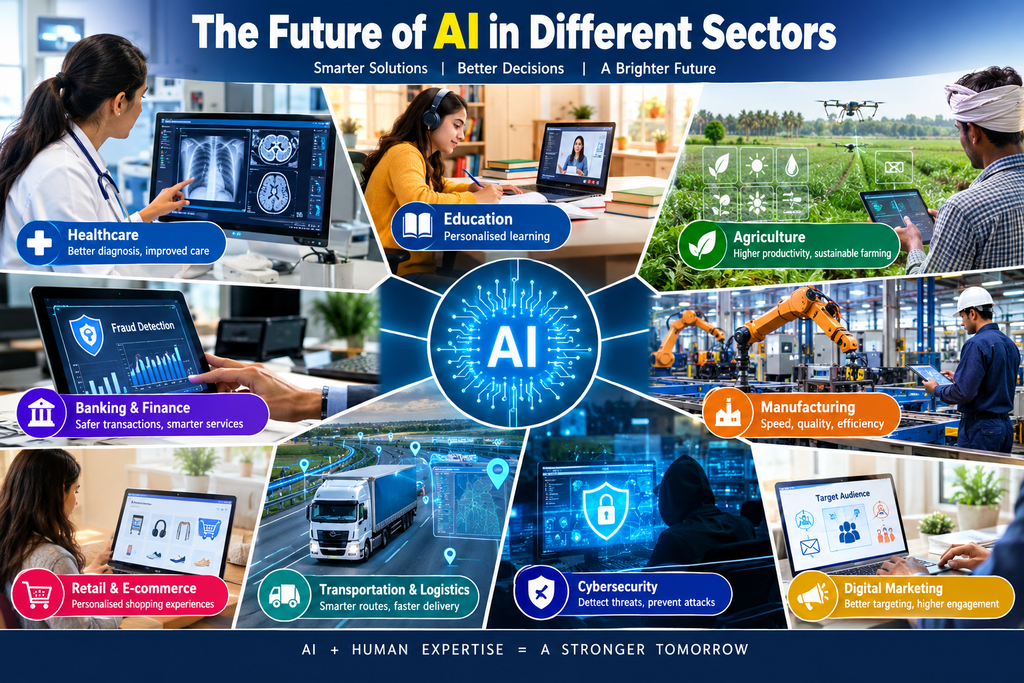
The future of AI across different sectors will not look exactly the same everywhere. Hospitals may use it to support medical professionals, schools may use it to personalise learning, farmers may use it to improve crop management, and businesses may use it to understand customers and organise their operations.
These developments could create valuable opportunities, but they will also require responsible decisions. AI can make mistakes, expose sensitive information, and change the nature of certain jobs. Its benefits will depend on the quality of the technology, the people using it, and the safeguards surrounding it. With this article, we can say that Future of AI in different sectors is takes place very fast.
My final advice is to approach AI with curiosity rather than fear or blind excitement. Learn how it works, try tools that solve real problems, and develop the skills that help you make good decisions.
AI is likely to become an increasingly important part of everyday life, but the real difference will come from how thoughtfully people choose to use it. So, it is clear that Future of AI in different sectors is increasing day by day.